
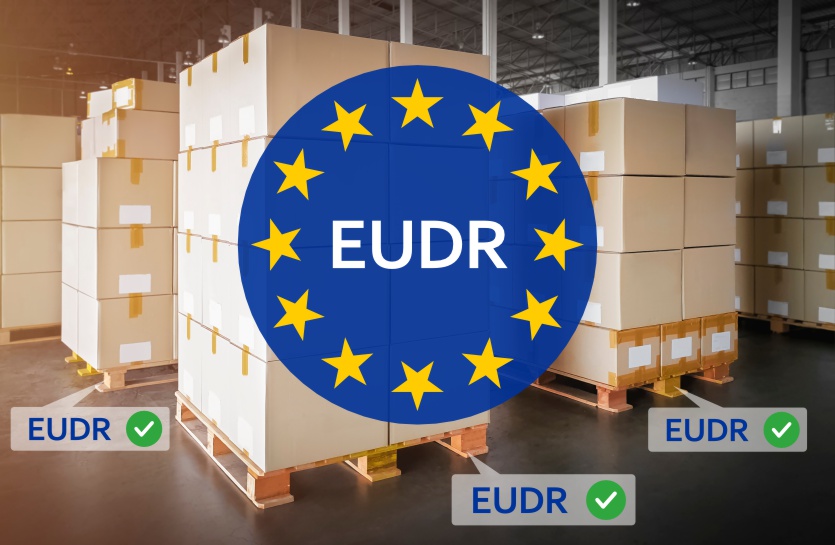
The EUDR Regulation (EU 2023/1115) is raising more and more questions among companies that use wooden pallets. No wonder - starting December 30, 2025, large and medium-sized enterprises, and from June 2026 also small and micro businesses, will be required to comply with the new rules. Many logistics managers are asking: Does using pallets mean new obligations and additional costs for me?
In short, no - provided the company does not introduce new pallets to the market and instead uses solutions based on recovery and reuse. The good news is: if you work with a trusted partner for pallet recovery and reuse, you won’t bear the costs or responsibilities associated with EUDR. It’s also worth choosing a supplier who can confirm this with documentation and take on operational responsibility. Let’s explore this in more detail.
Why is EUDR a challenge?
The primary goal of Regulation (EU) 2023/1115 on deforestation-free products is "to reduce greenhouse gas emissions and biodiversity loss by promoting the consumption of deforestation-free products and limiting the EU’s impact on global forest degradation.
Why is compliance with these regulations so important in terms of environmental responsibility? We’ve already discussed the role of this regulation in the article "EUDR and its impact on the sustainable management of wood packaging".
The new rules require documentation proving that the wood used to produce pallets comes from legal and sustainable sources.
The most significant burdens fall on:
- Pallet manufacturers and importers must conduct due diligence, collect data on wood origin, and assess the risk of deforestation.
- Distributors (traders) are responsible for ensuring traceability and documentation.
Who pays for EUDR and who doesn’t?
The entity that places pallets on the EU market (the manufacturer, trader, importer, or known as the "operator") or exports from the EU, pays and reports. They are responsible for complete documentation regarding the origin of the wood.
The pallet user who does not place pallets on the market but uses already introduced pallets (used, repaired, etc.) does not pay or report.
What must a supplier/partner from the EU have to relieve a company from EUDR costs?
- Raw material sources: FSC/PEFC-certified wood or wood from state forests; certificates support compliance (though they do not replace risk assessment).
- Full traceability "from forest to customer", including references to declarations of conformity for pallets placed on the market.
- Service and repairs to standard: work in accordance with EPAL requirements and transparent quality classification sheets.
- Reporting for the client: summaries for ESG, internal audits, and partner inquiries.
Frequently Asked Questions About EUDR
Below, we have compiled the most frequently asked questions and answers regarding who is responsible for implementing or providing the appropriate documents related to the EUDR, and at what stage.
I buy new pallets from a supplier in the EU for transporting my goods. Am I subject to EUDR regulations?
In this case, the due diligence obligation lies with the pallet supplier (manufacturer, importer, etc.). This entity is required to provide all documents confirming the legality of the wood. When purchasing pallets from Rotom, you can be assured of receiving all required data in accordance with EUDR regulations.
I buy wooden pallets for transporting goods from a supplier outside the EU. Am I subject to EUDR regulations?
If your company buys pallets from outside the EU, it is entirely subject to EUDR regulations, as it is the first entity placing the pallet on the EU market. Your company must then carry out due diligence procedures, collect geolocation data, required certificates, and conduct a risk analysis.
Do used or repaired pallets comply with EUDR?
EUDR applies to the first placement of a product on the market. Reusing a pallet that has already been in circulation does not constitute a new placement, so it does not create new obligations for you. When buying used pallets, both parties to the transaction are exempt from this obligation. For this, both parties must collect and store sufficient documents as evidence that show pallets consumed are indeed re-used.
I receive goods from a supplier on wooden pallets. Am I subject to EUDR regulations?
If you only purchase the goods (the actual product) and the pallet is merely transport packaging that is not resold or placed on the market, typically, you are not considered an entity placing wood on the EU market. The obligation lies with the pallet importer or manufacturer.
Does plastic "bypass" EUDR?
EUDR applies to specific raw materials, including wood. Other carriers, such as plastic pallets, may be a process alternative, but it’s still worth calculating the total cost and environmental impact; often, repairing and recovering wooden pallets remains the most cost-effective and least resource-intensive option.
Recovery instead of buying new pallets
One of the simplest ways to avoid EUDR-related costs and formalities is to recover your own packaging regularly. This way, most pallets you send with products to customers return to your company and are ready for reuse. Instead of buying new ones, you can use the same carriers, extending their lifecycle many times over.
There’s a common belief that packaging recovery requires extensive infrastructure and is costly. In practice, it’s quite the opposite - outsourcing this process to a logistics partner means you don’t need to invest in your own repair, sorting, or pallet circulation systems. At Rotom, we do this for you, using a proven network of warehouses and packaging registration technology.
Each shipment of your products is automatically recorded in the IT system - this way, you know where and when the pallets reach the customer. Then, Rotom collects the empty packaging, transports it to the nearest warehouse, sorts it, and repairs it if necessary. Verified and clean pallets are delivered back to your company in a just-in-time model.
As a result, the company notes lower CAPEX and OPEX for packaging, has less "dead" inventory, experiences shorter downtimes, and avoids EUDR formalities because it does not place new pallets on the market.
Pallet repair and service - savings and responsibility
Intensive pallet use means damage is inevitable. It can pose risks in the warehouse, generate waste, and reduce transport safety. That’s why professional repair is crucial.
At Rotom, we repair pallets in accordance with EPAL standards and hold licenses to perform these services at our branches. Each repaired pallet meets quality standards, making it fully interchangeable and safe in circulation. Importantly, repair (with usage of used components) is not considered a new market placement - so it does not trigger EUDR obligations.
Regular maintenance and repair of pallets is a real contribution to sustainable development. By extending the lifecycle of pallets, you reduce tree felling, lower CO2 emissions, and simultaneously cut the cost of purchasing new packaging.
Summary
EUDR is changing the rules of the game in European logistics, but it doesn’t have to mean additional burdens for your company. Recovery, repair, and pallet pooling are solutions that not only eliminate regulatory obligations but also genuinely reduce costs and improve process efficiency.
By choosing to work with Rotom in pallet recovery and reuse, you:
- Bear no costs or responsibilities related to EUDR,
- Gain cheaper and more efficient logistics,
- Receive complete compliance documentation,
- Build the image of a company operating in the spirit of sustainability,
- Support a circular economy and waste reduction.
At Rotom, we’ve been helping clients build sustainable logistics for years. Thanks to certified wood sources, professional infrastructure, and IT systems, we take on the responsibility related to EUDR. Your company can operate safely, modernly, and without additional costs.
Would you like to discuss the possibility of cooperation in packaging reuse? Contact us, and Rotom specialists will help you choose the right solutions for your supply chain.