Pallet markings are essential for safe, compliant, and efficient international logistics – yet they remain one of the most commonly misunderstood elements in global supply chains. This guide explains not only what the markings mean, but how they prevent delays, reduce exceptions, and protect product integrity across modern logistics networks.
The role and importance of pallet markings in global logistics
Pallet markings act as a universal operating system for global trade. They determine whether a pallet can cross borders, whether it is safe to load, and how it should be handled in warehouses, transport hubs, and automated environments. For logistics teams, these markings are not just symbols – they are a built in risk management tool that supports:
- Regulatory compliance in international shipments
- Phytosanitary safety, preventing pest related delays
- Operational efficiency, enabling faster checks and smoother flows
- Traceability across producers, treatments, and batches
- Sustainability through controlled reuse and lifecycle visibility
A solid understanding of these markings reduces uncertainty, avoids costly disruptions, and keeps pallets moving smoothly through the supply chain.
ISPM 15: The global standard explained
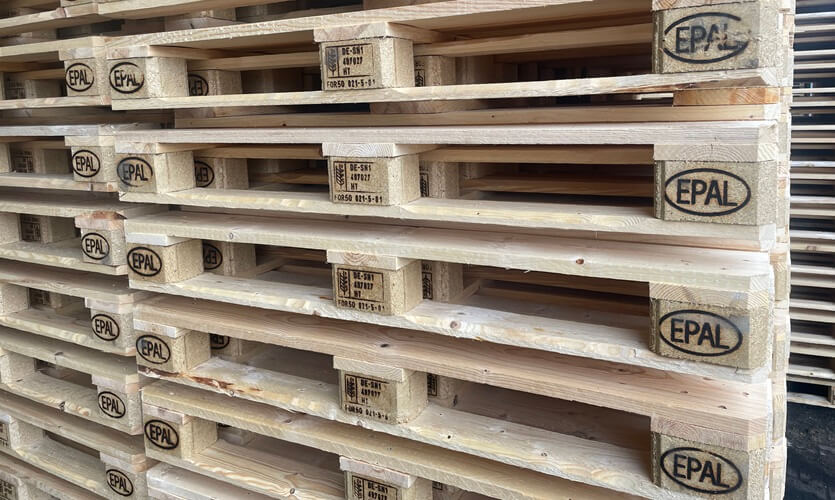
ISPM 15 governs wooden packaging materials in global trade, including pallets, crates, and dunnage. Its purpose is simple: prevent harmful organisms from crossing borders. Untreated wood can harbor insects, fungi, and larvae that threaten ecosystems and agriculture. Every compliant pallet carries the ISPM 15 mark, which includes:
- Country code (e.g., NL, DE, US)
- Unique producer number
- Treatment code (usually HT)
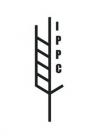
- The IPPC wheat ear symbol (confirming international phytosanitary recognition)
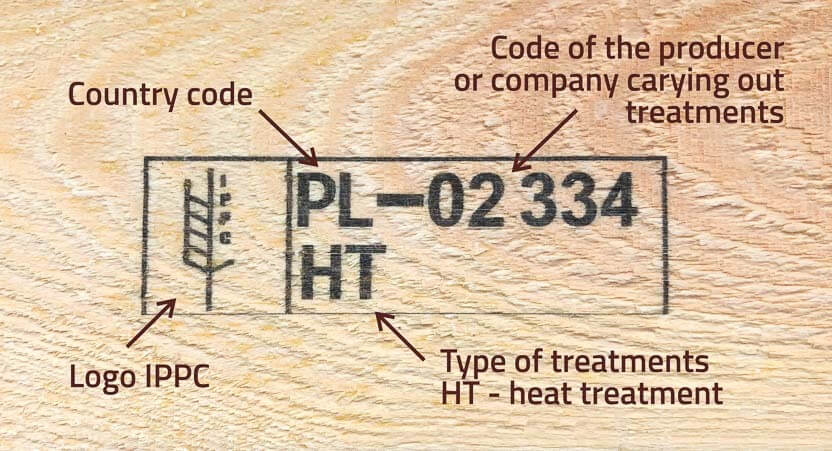
This stamp allows customs and logistics partners to verify compliance instantly – no paperwork required.
Heat treatment and moisture control
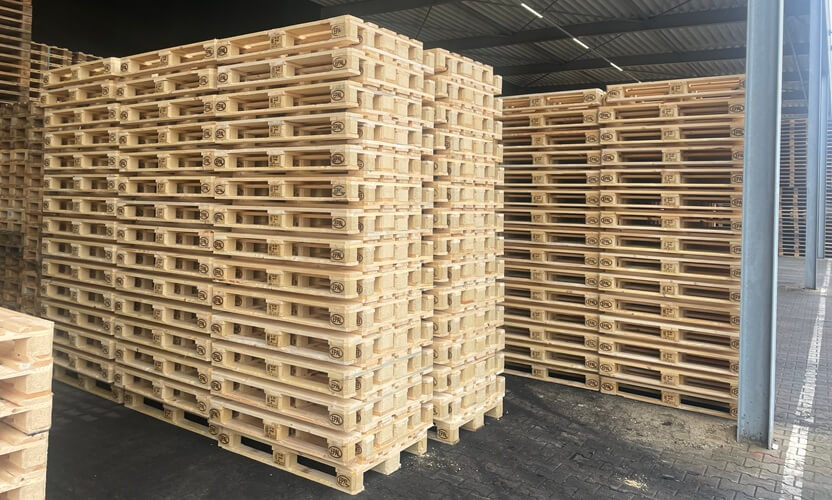
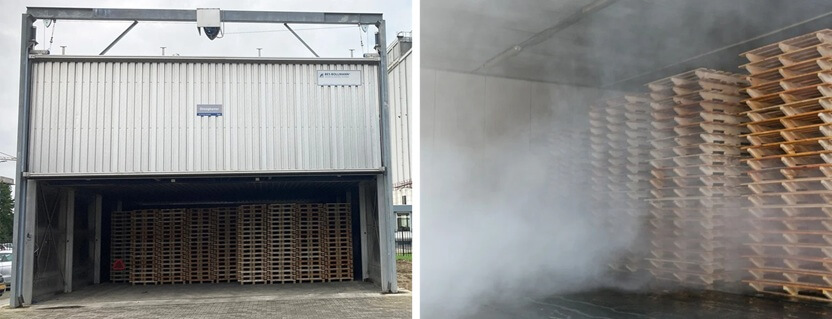
Heat treatment (HT) is the primary method used to meet ISPM 15 requirements. The wood is heated to 56°C for at least 30 minutes, eliminating insects, larvae, and fungi. Beyond compliance, HT improves pallet performance by:
- Lowering moisture content
- Reducing mold risk
- Improving dimensional stability
- Avoiding chemical residues
- Extending lifespan in humid or variable climates
HT is often confused with kiln drying (KD), but the two serve different purposes. KD reduces moisture for stability, while HT ensures phytosanitary compliance. Some pallets carry both markings (HTKD), but KD alone does not meet export requirements.
Key pallet markings and what they mean
Pallet markings show how a pallet was treated, built, and should be used. The table below summarizes the most important ones for logistics operations.
| Category | Marking / Term | Meaning | Why it matters |
|---|---|---|---|
| Material & Construction | IPPC symbol | International wheat ear logo used on all ISPM 15 compliant wood packaging | Confirms global phytosanitary recognition; required for export |
| DB (Debarked) | Bark removed; required for ISPM 15 | Prevents pests from hiding under bark | |
| EPAL / EUR | European pallet pool standard | Ensures consistent quality and repair rules | |
| CP1–CP9 | Chemical industry pallet types | Matches pallet design to drums, bags, and chemical packaging | |
| VMF-markering | Certified French producer/repairer | Ensures pallet quality and traceability | |
| Treatment Codes | HT | Heat Treatment | Mandatory ISPM 15 treatment for export |
| MB | Methyl Bromide fumigation | Banned in many regions; signals older/non‑EU pallets | |
| KD | Kiln Dried | Reduces moisture; not ISPM compliant alone | |
| HTKD | Heat treated and kiln dried | Meets ISPM 15 while improving pallet performance | |
| Traceability Identifiers | Laser engraved ID | Permanent code | Supports pooling, audits, and lifecycle tracking |
| QR code | Scannable identifier | Enables fast inbound/outbound scanning | |
| RFID tag | Radio frequency chip | Ideal for automated, high‑volume environments |
These markings help teams quickly assess whether a pallet is suitable for a specific product, warehouse setup, or export destination.
The real operational impact of pallet markings
Pallet markings influence far more than compliance – they determine how smoothly goods move through real logistics environments. Clear, correct markings reduce exceptions, delays, and cost across the entire flow. Their operational impact shows up in five critical areas:
- Automation readiness - Unreadable or missing markings trigger manual handling, slow down conveyors, and cause Automated Storage and Retrieval System (AS/RS) rejects.
- Retail compliance - Distribution centres frequently refuse pallets without valid ISPM 15 stamps, leading to rework, relabelling, or full load rejection.
- Cross border flow - Incorrect treatment codes cause customs holds, phytosanitary inspections, and multi day delays.
- Damage prevention - Proper treatment and traceability reduce mold, infestation, and structural failures that lead to product loss or emergency repacking.
- Sustainability & costs - Accurate markings support reuse cycles, repair programs, and cost per trip optimization in pallet pools.
Additional operational factors beyond pallet markings
These practical characteristics help determine whether a pallet is safe, compliant, and suitable for use. They are not markings, but they play a major role in daily logistics decisions.
| Factor | What it means | Why it matters |
|---|---|---|
| Colour Codes | Pooling colours (CHEP blue, LPR red, PECO red, IPP red) show pallet ownership | Ensures correct return flows and prevents misuse of rented pallets |
| Load Capacity Ratings | Dynamic, static, and racking load limits define safe weight handling | Prevents pallet failures and protects products during movement and storage |
| Quality Grades (A–C) | A = clean/intact, B = repaired but sound, C = heavily used | Helps match pallet condition to product, automation, and cost needs |
| Risk Indicators | Missing stamps, damage, contamination, moisture, mold | Flags unsafe or non‑compliant pallets early to avoid delays and damage |
| Dimensions & Compatibility | Standard sizes (EURO 1200x800 mm, ISO 1200x1000 mm) and deck spacing | Ensures fit with racks, conveyors, forklifts, and export requirements |
Considering these factors alongside formal pallet markings helps logistics teams choose the right pallet for each application and avoid avoidable risks in handling, storage, and transport.
Common misconceptions about pallet markings
Even experienced logistics teams encounter recurring misunderstandings. Addressing these myths helps avoid compliance issues and operational delays:
- "KD is a substitute for HT."
Kiln drying improves stability, but only heat treatment satisfies ISPM 15 export requirements. - "Pallet colour shows the treatment method."
Pooling colours indicate ownership, not phytosanitary compliance. - "MB marked pallets are still being produced."
Methyl bromide fumigation is banned in many regions; MB pallets may still circulate, but new ones are no longer produced. - "ISPM 15 compliance means a pallet is operationally suitable."
Compliance does not guarantee correct dimensions, load capacity, or condition for a specific warehouse or product.
Key takeaways about pallet markings
Pallet markings form the core of safe and compliant global logistics, enabling quick verification of treatment, origin, and traceability. But markings alone don’t determine whether a pallet is fit for use. Operational factors such as colour codes, load capacity, quality grades, risk indicators, and dimensional compatibility complete the picture. Together, they give logistics teams a clear, practical framework for selecting the right pallet, reducing risk, and keeping goods moving efficiently across the supply chain.
Frequently Asked Questions (FAQ) about pallet markings
Understanding pallet markings is not always straightforward, and misinformation is common across global supply chains. Below, we answer the most frequent questions about what these markings mean, how they work, and how they affect daily logistics operations.
What does the ISPM 15 stamp actually guarantee?
The ISPM 15 stamp confirms that the pallet has been properly treated (usually HT) to eliminate pests and is legally accepted for international transport. It does not guarantee pallet quality, load capacity, or suitability for automation.
Is kiln drying (KD) enough for export shipments?
No, kiln drying improves moisture stability but does not meet ISPM 15 requirements. Only pallets marked HT or HTKD are accepted for export.
Why do retailers reject pallets even when they have an ISPM 15 stamp?
Retailers often reject pallets due to damage, contamination, incorrect dimensions, or poor condition – even if the ISPM 15 marking is valid. Compliance does not replace operational suitability.