

In recent years, the concept of green logistics - until recently treated by many companies as a CSR add-on - has become one of the key drivers shaping the European transport and supply chain market. This shift is driven by several forces: rising raw material costs, new EU regulations, pressure to reduce emissions, and growing expectations from end customers and business partners.
Yet many reports, analyses, and articles on sustainable logistics are still full of declarations: “we aim for net zero,” “we promote circularity,” “we focus on recycling.” They rarely include hard data: How much does it cost? When will it pay off? What does it look like operationally? What happens when things go wrong?
That’s why this article focuses on specifics: what is actually happening in Europe, which facts matter, what EU regulations are changing, what risks and costs companies must consider, and how Rotom implements sustainable logistics in practice-through rental, repairs, recovery, and recycling of packaging.
What Is Really Driving Green Logistics in Europe? - The Facts You Need to Know
The Green Deal and Fit for 55 - a Legal Obligation, Not a Trend
The EU’s European Green Deal strategy and the Fit for 55 legislative package assume a 55% reduction in greenhouse gas emissions by 2030. It is not a vision - these are legally binding targets (European Green Deal / Fit for 55).
For logistics, this means, among other things, new CO₂ emission standards for heavy-duty vehicles (HDVs), mandatory emission reporting for transport, and the need to implement solutions that reduce the carbon footprint - such as reusable packaging and a circular economy.
Maritime Transport Under the ETS - Emission Costs Now Apply
Since 2024, maritime transport has been officially included in the EU ETS, meaning real, measurable costs for CO₂ emissions ( EU ETS for shipping).
It directly affects the cost of importing goods into Europe, especially from outside the EU. As a result, companies increasingly seek optimisation-such as reducing the weight and volume of transported packaging.
Packaging Recycling Pressure - Facts and Statistics
In 2023, EU countries generated nearly 80 million tonnes of packaging waste-an average of 178 kg per person (Euronews, 2025). Meanwhile, some EU countries have already achieved recycling targets for 2025-2030, which is accelerating pressure on the entire market - including logistics, suppliers, and operators.

Sustainable Transport Is Growing Faster Than Expected
According to the European Logistics & Supply Chain Sustainability Report 2024, logistics companies across Europe are implementing ESG strategies, investing in the circular economy, expanding low-emission transport solutions, and adopting reusable packaging models.
These numbers prove that sustainability is not an empty trend-it is the result of complex realities: EU regulations, rising material and emission costs, customer expectations, and environmental responsibility.
Rotom aligns not through declarations but through action: by enabling full packaging circulation, repairing and recycling materials, offering pooling solutions, and providing flexible cooperation models.
Operating in 10 European countries, Rotom has spent years building a sustainable logistics model based on a closed-loop approach: rental, repair, recovery, and recycling of packaging. What does this look like in practice?
Packaging rental instead of purchase - flexibility and no frozen capital
Rental of logistic means allows companies to avoid additional investments in packaging, adjust the number of load carriers to seasonality, reduce the costs of storing surpluses, and use high-quality packaging without the expenses of its maintenance. It is a particularly profitable model given the rising costs of raw materials.
Real Customer Example - Rental of Roll Containers Supported Rapid Organisational Growth
When the pandemic halted production and supply of new roll containers, rental became the only viable solution for a fast-growing retail chain to maintain operational continuity. Because Rotom had a large pool of high-quality roll containers and could deliver 12,000 units within a few days, the customer’s supply chain avoided a critical stoppage.
In practice, over just a few days, the customer received 40 truckloads, each carrying 300 containers. The rental period lasted 3–4 months, after which the containers were returned to Rotom. The potential losses from a supply chain shutdown would have been enormous, so the speed and scale of delivery proved essential. (More examples and benefits are described in the white paper: Rental, shared usage of logistic means.)
Packaging Optimisation - Circular Economy in Action
A closed loop of packaging is a process in which returnable packaging circulates between the supplier and the recipient in a closed cycle:
- sent to the customer with goods,
- collected after delivery,
- inspected and serviced,
- returned to circulation.
Such a circulation of logistics packaging reduces the production of new packaging, waste, CO₂ emissions, and packaging management costs.
Real Customer Example - Packaging Pooling Cut CO₂ Emissions and Boosted Operational Efficiency
With Rotom’s expertise, a European 3PL operator replaced single-use stretch film in roll containers with reusable integrated walls. The project involved modifying between 100,000 and 1,000,000 units, eliminating the need for film wrapping.
The results were substantial:
- CO₂ emissions per container declined by 86% (from 143 g to 20 g),
- Security costs decreased by 70% (€0.17 → €0.05),
- Operation time shortened by 83% (60 s → 10 s),
- Each set of walls lasts around 1,000 cycles.
It allowed the company to simultaneously reduce environmental footprint, labour time, and operational costs. (More examples available in the white paper Returnable logistic carriers instead of disposable ones.)
Repair and Valuing Used Packaging
Proper repairs can extend the life of pallets and other packaging by several years. Reconditioning pallets costs 40–60% less than buying new ones, and technical inspections help recover value from seemingly unusable units.
Real Customer Example - Pallet Repair Delivered Significant Savings
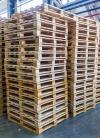
Rotom serviced five plants for a major Polish brewery, handling sales, repairs, and buybacks of EPAL pallets. Over two years, 120,000 pallets were repaired-around 60,000 per year.
Heavily damaged pallets were collected as scrap. When the customer could not increase its pallet pool, Rotom delivered operational pallets in the same transport, ensuring supply continuity.
The customer gained:
- complete relief from pallet logistics,
- a stable pallet supply,
- substantial savings (repair cost was only 20–35% of a new pallet price).
It made the pallet loop more sustainable and economical without requiring internal resources. (More examples in the white paper Product life time extension is sustainable.)
Material Recycling - Product Responsibility in Practice
Rotom also supports customers by ensuring the responsible recycling of wooden packaging, tailored to each company’s needs.
We buy pallets either as products-restored for reuse-or as waste material, which we pass on for proper disposal. After quality analysis, we issue recycling documentation that helps companies reduce product fees.
Real customer example - optimisation of pallet circulation reduced the amount of waste
A customer in the recycling industry needed a partner to take over the regular collection and sorting of pallets from multiple locations and to enable the recovery of value from single-use and EPAL pallets. Client implemented a flexible model, including collection with our own transport or a trailer swap, daily on-site or logistics centre sorting, and complete transparency. Each delivery ends with a report on the number, type, and condition of pallets, which serves as the basis for the buyback offer.
Results:
- stable monthly collection of 7,000–12,000 pallets,
- significant waste reduction through component recovery,
- increased value return from packaging,
- large operational scale (127 transports in 2024; 111 by July 2025).
This model strengthened operational continuity, reduced material losses, and supported sustainability goals. (More examples in the white paper Returnable logistic carriers instead of disposable ones.)
Take Practical Steps Now
Green logistics is not a trend—it’s a set of concrete operational decisions. Today, companies aren’t looking for more environmental slogans. They’re looking for solutions that make financial, operational, and environmental sense simultaneously.
When planning transformation, consider:
- What processes support the solution?
- Who handles the recovery and rotation of packaging?
- How do servicing and repairs work?
- What are the real lifecycle costs?
- Which risks must be considered?
Rotom offers all of this within its cooperation model-and with its European network and experience, can support both local and international projects.
If your company wants to move from declarations to a truly functioning sustainable logistics model, start by talking to a partner experienced in rental, recovery, repair, and recycling of packaging.
Rotom helps European companies build circular packaging systems and reduce operational costs-practically, not theoretically. Contact us to find out how similar solutions could work in your organisation and what benefits they can deliver in the first months of implementation.